Make Your Cat or Dog Do the Shan Shen Bu (What Works)
 Shan Shen Bu AI Team
Cats and dogs can do the shan shen bu in AI video, within limits. Pet photo rules, why anatomy drifts, prompts that keep fur and markings, plus a workflow.
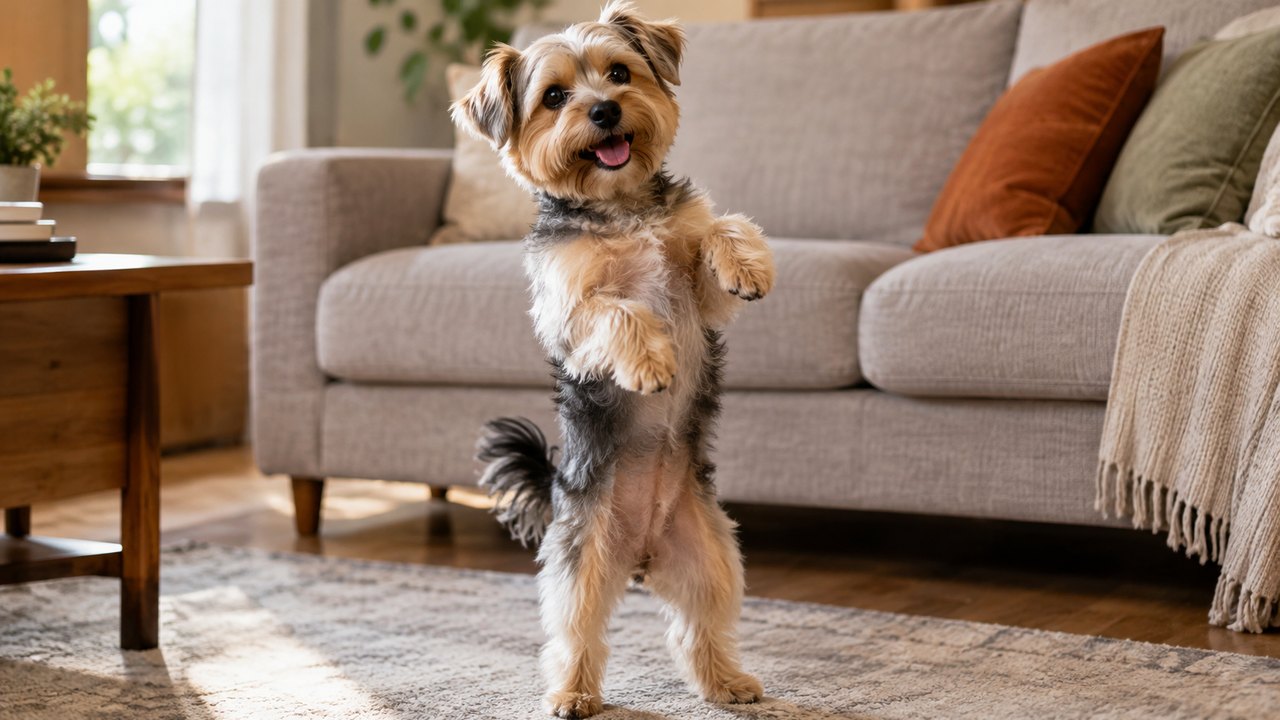
Yes, your cat or dog can perform the shan shen bu in a generated video. It is also the hardest version of the trend to get right. The routine was built for two legs and two arms. A pet has four legs, a tail, a snout and a coat pattern, and the model has to translate a human dance into that body without turning your dog into a furry person.
That translation is the whole appeal, and it is also where renders go wrong. Expect a funny, stylized clip rather than a realistic dancing animal. If you accept that, the pet version is one of the most shareable formats in the trend, because the humor is instant and the subject is yours.
This guide covers which pet photos work, why the anatomy drifts, a prompt that protects fur and markings, and a realistic workflow.
Esempio caricato: modificalo o genera.
This clip: 30 credits · 11 clips a month for $39.90 (Pro), or 120 a year for $319
Why the pet version is harder
The four beats assume a human skeleton:
- The flash step needs a wide two-foot stance and a low crouch.
- The langzi kick needs one knee to lift while the other leg carries the weight.
- The bear shake needs arms to fling up and out.
- The head sway needs a neck that can rock the head without moving the shoulders.
A cat or dog has to fake all four. Models handle this by anthropomorphizing: lifting the front paws, standing on the hind legs, or briefly drawing a human-like torso. That is where extra limbs, stretched bodies and human hands on a dog appear.
There is a second problem: fur. A coat pattern is high-frequency detail, and models tend to simplify it. Stripes soften, patches drift, white socks move up or down the leg. The result still reads as your pet, but it is rarely a pixel-perfect copy.
Which pets and photos work best
Short-haired cats and dogs with clear, high-contrast markings tend to hold up better than long-haired or all-white animals, because there is more visual structure for the model to track. Upright or sitting poses give the model a head start on the two-legged translation.
The best pet photo has:
- One animal only. No second pet, no person holding the animal.
- Sharp focus on the face and eyes. A blurry pet photo produces a blurry pet render.
- Even daylight. Avoid a single hard light source that splits the face.
- Full body, all four paws visible. The model needs to know where the legs are before it moves them.
- A plain background. A patterned sofa or a cluttered floor gives the model too much to invent.
- No costume. A sweater hides the body shape the model is trying to keep.
- A real camera photo, not a screenshot. Screenshots lose detail and often carry interface elements.
If your only photo is your cat curled on a couch, the render will still work, but expect the model to invent a standing pose and lose some markings in the process.
Why anatomy drifts
| What you see | Why it happens | | -------------------- | ------------------------------------------------------------------------------ | | Extra legs | The model blends the hind legs with the front paws during the kick | | Human hands | The bear shake asks for arms, and the model supplies hands | | A stretched torso | Standing a quadruped upright requires a body the animal does not have | | Fur pattern changes | High-frequency detail is simplified between frames | | The tail disappears | Fast movement and a busy background let the tail merge into the scene | | The face turns human | The identity lock was too weak or the prompt asked for "dancing like a person" |
None of these mean the tool is broken. They are the cost of asking a quadruped to perform a bipedal routine. You reduce them by keeping the clip short, the camera fixed and the instructions specific.
A prompt that keeps fur and markings
A cosy living room with a sofa, a rug and warm afternoon window light. The subject is the cat or dog from the reference photo, standing on its hind legs and doing a playful four-beat shan shen bu: a quick side-step with the front paws lifting, a small kick to the side, a full-body shake of the fur, then a head sway into the camera. Keep the animal's exact breed, fur color and markings; do not turn it into a person, do not add human hands, and do not add a second animal. Fixed low camera, one continuous take, vertical 9:16, no text, no watermark.
Four clauses do the heavy lifting:
- "The cat or dog from the reference photo." This anchors identity without asking the model to read your mind.
- "Standing on its hind legs." It sets the pose before the beats begin, which reduces mid-clip transformations.
- "Keep the exact breed, fur color and markings." It gives the model a reason to preserve the coat.
- "Do not turn it into a person, do not add human hands." It blocks the most common failure directly.
Do not write "dances like a human." That phrase invites exactly the anthropomorphism you are trying to control. Write the four beats as animal movements: a side-step, a small kick, a shake of the fur, a head sway.
Realistic expectations
- The first render usually has a leg problem. Plan for two to four attempts.
- The kick will read as a hop or a paw lift. A precise langzi kick needs a knee the animal does not have.
- The shake is the strongest beat. Fur shaking is something the model understands well, and it looks good even when the rest is imperfect.
- Cats suit the deadpan. A flat feline face during the head sway is the funniest frame in most cat renders.
- Dogs read as happy, not deadpan. That is fine; the joke shifts from deadpan to eager.
- Keep it to ten seconds. More time gives the model more chances to drift.
If you want the cleanest possible result, use a photo where the pet is already sitting upright, a plain background, and the pet preset scene. Those three choices remove most of the variables.
Step by step
- Pick the photo. Use the checklist above. One animal, sharp, full body, plain background.
- Choose the pet living room scene. It provides a low camera and warm light that flatter animals.
- Paste or confirm the prompt. Keep the four beats short and animal-specific.
- Set 720p and 10 seconds. This is 30 credits, the studio default.
- Check the credit cost. A failed render refunds automatically, so a bad attempt is not wasted money.
- Generate and wait. Renders run as tasks; you can leave the page and come back.
- Review the kick frame and the final look. Pause on the kick to count legs, and check the face at the end.
- Download the MP4 and label it. The clip is silent, so add a sound in TikTok and say it is AI.
If the first attempt adds legs, shorten the clip and remove the kick from the prompt, keeping the side-step, shake and head sway. Three beats that look clean are better than four that fall apart.
Honesty and animal welfare
No real animal performed the routine. The clip is generated from a photo, and your pet was never asked to stand, kick or shake on cue. Say so when you post. "AI pet dance" is a complete caption and it does not lessen the joke.
A few more rules worth keeping:
- Use a photo of your own pet, or one you have permission to use.
- Do not generate a clip that implies a real animal was trained or stressed for it.
- Do not attach audio that suggests the animal was responding to a command.
- Do not upload a photo that shows a person's face or identifying details in the background.
The pet version is popular because it is absurd and affectionate. Keeping it clearly fictional protects both.
FAQ
Can I use a photo of my cat lying down?
Yes, but the model has to invent a standing pose, and that is where anatomy errors start. A sitting or upright photo gives a better result.
Why does my dog end up with extra legs?
The routine is bipedal, and the model is translating four legs into a two-legged dance. Shorten the clip, specify "two hind legs on the floor," and remove the kick if the problem persists.
Will the fur pattern stay the same?
Usually close, not exact. High-contrast markings drift most. A sharp, evenly lit photo with the full coat visible gives the model the best chance.
Can I make two pets dance together?
It is possible, but one animal per render is much more reliable. Two animals double the chances of merged bodies and swapped markings.
Does the pet need to be trained?
No. The video is generated from a still photo. Nothing is asked of the animal, and no real footage of it moving is used.
Make your pet's clip
Open the pet scene feature page to see the preset, or read the photo tips article if your first photo came out soft. The pricing page lists credit packs, and the studio on the home page is where the render happens. Start with one 10-second attempt, then adjust from what you see.
Guide correlate
What Is Shan Shen Bu? Meaning, Origin and the Four Moves
Shan shen bu means flash step: a four-beat Chinese dance routine that went viral in 2026. Here is where it came from and what AI can and cannot do.

How to Make a Shan Shen Bu Video From One Photo
Turn one clear photo into a 10 to 15 second vertical shan shen bu clip. The full eight-step workflow, a photo checklist and the failures to expect.
Shan Shen Bu AI Prompts That Keep the Face and the Moves
A six-part prompt formula for shan shen bu AI video: subject, scene, four-beat action, camera, identity lock and exclusions, with four full examples.